
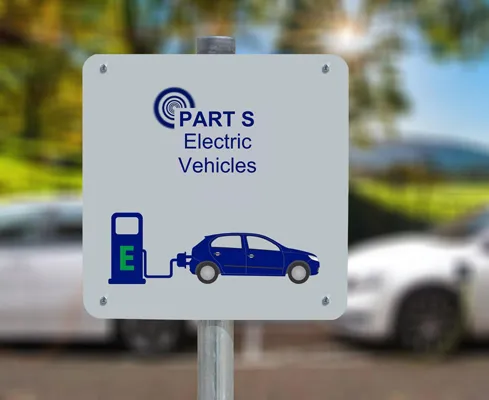
What is the all-new Part S? And what does it mean for the construction industry?
Part S is an all-new building regulation approved document set to come into force in June 2022. Its main concern is with future proofing both domestic and non-domestic developments. So, what is this document? Why is it needed? And how will it affect the construction industry?
- What is Part S?
Approved Document Part S is titled ‘Infrastructure relating to the charging of Electric Vehicles’. It applies to the following building types/works:
- New residential buildings
- New non-residential buildings
- Buildings undergoing a material change of use
- Residential buildings undergoing major renovation*
- Non-residential buildings undergoing major renovation*
- Mixed-use buildings undergoing relevant building work
With a few exceptions, buildings undergoing these works will require at a minimum the installation of a 7kW untethered EV charger, or cable routes capable of providing supply. 7kW will provide around 30 miles of range per hour of charging.
*Defined as being renovation work to a carpark within the site, a change in the electric infrastructure of a car park, or in the electrical infrastructure of a building with a car park inside.
- Why are these extra regulations needed?
In a study carried out in the UK, issues relating to infrastructure were found to be some of the biggest concerns for drivers. When asked why they wouldn’t be going electric the next time it came to buying a car 37% of people said they were concerned about a lack of fast charging points, while another 30% said the inability to charge the car at home was preventing them.
Due to climate change, governments and manufacturers are wanting to move away from Internal Combustion Engine (ICE) vehicles. The UK is set to ban the sale of all new cars using ICEs in 2030, and almost all major manufacturers from Ford to Ferrari have committed to either stopping producing ICE cars altogether, or to offering pure-electric alternatives in the near future. This means that electric cars have never been more widely available and easy to get, and there has never been a more relevant time to consider the alternatives ICE vehicles.
The purpose then of these regulations is to ensure infrastructure matches ambition when it comes to investment in EV technology. Consumers will have greater confidence that EVs will meet their day-to-day needs, and manufacturers will in turn have confidence that there is a market for EVs.
- How will it affect the construction industry?
As previously stated, all new builds and buildings undergoing a change of use or major renovation will require an EV charger. This means there are extra considerations for those in the construction industry, and more costs for the developers.
This cost of installation, which is capped by Part S at an average of £3,600 per point (or no more than 7% of the developments budget) is perhaps the most significant consideration. To install the EV chargers, checks will be needed to see whether the capabilities of the local grid are adequate, or if upgrades are needed.
Generally, the bigger the development, the more likely it is that upgrades will be needed. However, as the cost cap is an average across all points developers of large-scale projects are more likely to have the flexibility to install a mix of 7kW and 22kW chargers and do more upgrades. Developers of small-scale projects would likely only go for 7kW chargers to avoid the cost of installing 22kW points, which require a 3-phase supply.
As well as cost, the position of the chargers needs to be considered. If the parking spaces are too far from the power grid, the power drops associated with the length of the cable may negatively affect the charging capabilities of the point. For example, on a domestic installation there can be no more than 15 metres between the power grid and the EV charging point itself.
In conclusion, Part S is a piece of legislation that contributes to the future proofing of buildings. It aims to ensure that infrastructure will keep up with the car-buying market as consumers and manufacturers move towards EVs. To do this, the regulations cover a wide array of building works, stating that all new-build developments, changes of use, and renovation projects that meet certain criteria must have EV charge points. The EV charge points being installed will need to provide a minimum of 7kW to an untethered charger, or have the cable routes ready for this supply. This leads to an extra cost in developing projects. However, the regulations specify a cost cap of £3,600 on average for all work involved in installed points, and if the cost is set to exceed this, then developers need only install the cable routes. This stops the installation of EV chargers becoming prohibitively expensive. This will address the concerns of the UK car buyer, and will make greener EV’s a new design consideration in the way we develop our sites and homes in the UK.